The Love at the Intersection of the Dead and Living.
It's that time of year.
This month’s Dark Sabbath is especially dear to me. Día de los Muertos is my favorite holiday, and there is something about it that feels profoundly true to me: the flowers, the food, the candles, the photographs, the names spoken aloud, and the understanding that death does not necessarily erase relationship.
We remember. We prepare a place. We make an offering. We say, in all the ways available to us, you are still part of this story.
That feels very different from the way death is often treated in mainstream Western culture. We tend to hide it, soften the language around it, remove the body, move grief behind closed doors, and expect people to return to normal as though losing someone were an interruption instead of an alteration of the world.
Día de los Muertos offers another possibility. Death can be acknowledged without allowing it to consume everything. Grief can sit beside color. Memory can sit beside music. The dead can be spoken about with laughter as well as tears.
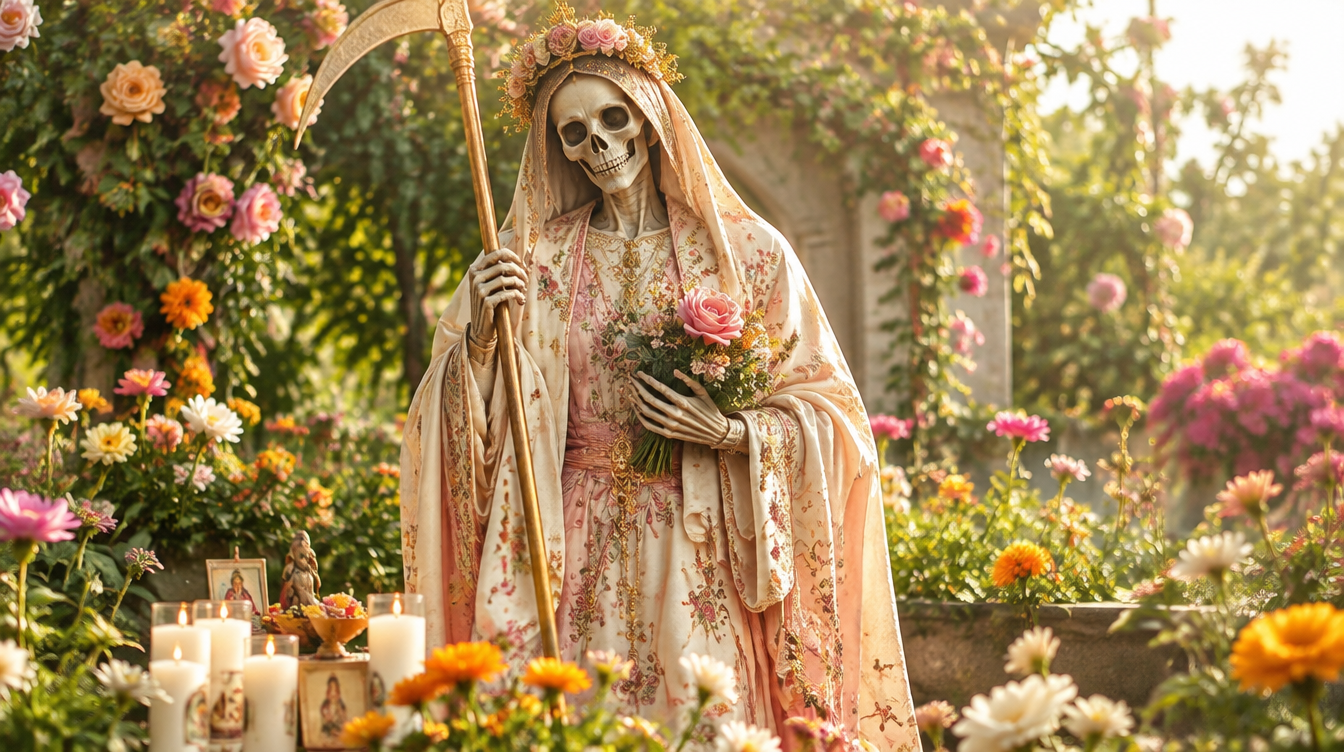
An altar can hold photographs, candles, marigolds, favorite foods, sweets, drinks, objects, stories, and ordinary evidence that somebody lived here and mattered. There is something incredibly tender about that. It says that love is not required to pretend death did not happen, and it does not require death to have the final word.
This month, we are also going to talk about Santísima Muerte.
I want to be careful here, because Santa Muerte and Día de los Muertos are not the same tradition. They are sometimes visually associated because both engage directly with death, and both exist within Mexican cultural landscapes where death has a very different public presence than it often does elsewhere. Still, Santísima is not simply the patron saint of Día de los Muertos, and Día de los Muertos is not a Santa Muerte holiday.
We are going to honor both without collapsing one into the other.
Those of you who know me know that I love Santísima. Deeply.
I do not experience her as frightening or macabre for the sake of being macabre. I experience her as honest.
Death does not flatter us. Death does not care about rank, money, beauty, respectability, citizenship, gender, success, failure, or whether the world considered us important. Death comes for everyone, and there is something strangely compassionate in that equality.
Santísima stands where many people would rather not look. She is frequently beloved by people who have felt forgotten, stigmatized, endangered, excluded, poor, criminalized, queer, sick, grieving, or otherwise pushed beyond the edges of respectable society.
She is approached for protection, healing, justice, safe passage, love, money, and companionship in places where polite spirituality may have very little to say.
That is part of what draws me to her.
She does not require death to become pretty before she will stand beside it. She does not require suffering to become inspirational. She does not require us to pretend mortality is a misunderstanding that sufficiently spiritual people can transcend.
She stands at the threshold and says: this too.
This body. This grief. This fear. This ending. This love that has nowhere obvious to go now.
This too belongs to the sacred.
I think there is enormous spiritual maturity in learning to sit near death without immediately trying to defeat it, explain it, or turn it into a lesson.
Sometimes death is simply terrible. Sometimes grief is not secretly a gift. Sometimes we miss someone because they should still be here. Sometimes the most sacred thing we can do is stop demanding that grief justify itself.
Día de los Muertos does not erase that pain. It gives it somewhere to go.
Build the altar. Light the candle. Bring the flowers. Cook the food. Tell the story again. Say the name.
Let the dead remain dead and still remain loved.
Remembering does not require us to decide exactly what happens after death. You may believe your ancestors literally return. You may experience the dead as spirits. You may understand the practice symbolically. You may be unsure. You may believe memory itself is a form of continued relationship.
Threshold does not require everyone to agree about the metaphysics.
We can still make room for reverence. We can still behave as though a life deserves remembering. We can still ask what changes when we stop treating death as contamination. We can still explore the extraordinary human impulse to keep speaking to the people we love after there is no longer a body available to answer.
I suspect many of us already do this.
We talk to our mothers, our fathers, our grandparents, our friends, our children, our beloved animals, and our ancestors we never personally knew. We tell them what happened. We ask them questions. We hear a song and think immediately of them. We cook their food. We repeat their expressions. We recognize their hands in our own hands.
The border between absence and presence is not always as clean as language would have us believe.
That is the territory I want us to enter together this month.
Not a haunted house. Not death as spectacle. Not Halloween with a religious costume thrown over it.
Something quieter, more beautiful, more serious, and more alive.
We are going to talk about the traditions and meaning of Día de los Muertos. We are going to talk about Santa Muerte, her history, her devotees, her symbolism, and the reasons she has become such a powerful figure for people who need protection at the margins.
We are also going to talk about death itself: grief, remembrance, ancestors, offerings, and what it means to continue loving someone whose body is gone.
And we are going to make some room for mystery.
For Dark Sabbath, I would love for you to bring a photograph or small object connected to someone who has died. It might be a family member, a friend, an ancestor, a beloved animal, or someone whose life mattered to you even if you never met them.
You can also bring a candle, something to write with, and a flower if you have one. Marigolds are beautiful and deeply associated with Día de los Muertos, but you do not need a particular flower.
This is not about recreating someone else’s tradition perfectly in your living room. It is about approaching the evening with reverence, curiosity, and care.
If you have a relationship with Santa Muerte already, you are welcome to bring an image or devotional object connected to her. If you do not, there is absolutely no expectation that you begin one.
Santísima does not need to become everybody’s saint.
We can learn about a sacred figure without claiming her. We can approach a tradition with respect without pretending it belongs to us in exactly the same way it belongs to people who inherited it.
That distinction is important.
Dark Sabbath is a place for spiritual exploration, not spiritual consumption.
I want us to leave the evening with more reverence than we arrived with. More comfort speaking the names of the dead. More capacity to sit beside grief without trying to hurry it away. More curiosity about the ways human beings have always maintained relationships across the boundary of death.
And perhaps a little less fear of the figure standing at that boundary.
Saturday, October 10 at 4:00 PM Pacific. Please RSVP to the Facebook Event notice if you plan to attend.
Online and free, as always.
Come with your questions, your grief, your curiosity, a photograph, and a candle.
Come sit with us between memory and mystery.
The dead do not need us to stop living. The living do not need to stop loving the dead.
There is room for both.
Love all ways,
Lisa
P.S. Threshold is a free spiritual community exclusively for women and femmes. There is nothing to buy, no coaching pitch, and no required belief system. Dark Sabbath is part class, part conversation, part ritual, and part spiritual care. You are welcome to participate fully, quietly, or simply listen.